
Blog Steel Commander Corp
Foundation Work Excavator at Steel Commander Corp Site.
When most people think about foundation and site preparation, they picture bulldozers pushing dirt around. But if you’ve been in the construction business for any length of time, you know the truth: what happens before the first steel beam goes up can make or break your entire project.
At Steel Commander Corp, we’ve seen it time and time again. The difference between a project that comes in on time and under budget versus one that turns into a costly nightmare often comes down to those critical first weeks of site prep and foundation work. And while steel buildings are inherently strong and durable, that strength means nothing if the foundation beneath them isn’t properly prepared.
Why Foundations & Site Prep Matter More Than You Think
Here’s a scenario we encounter more often than we’d like: a contractor calls us six weeks into a steel building project, frustrated and over budget. The steel is sitting on trucks, unable to be erected. Why? Because the foundation isn’t level, the anchor bolts are misaligned, or worse—the soil conditions weren’t properly assessed, and the foundation is already showing signs of settlement.
The irony? Proper site prep and foundation work typically represents only 10-15% of a total project budget, yet it influences 100% of everything that comes after.
The Foundation Is Your Building’s Performance Anchor
Think of your foundation as the interface between the earth and everything engineered above it. Steel buildings are precision-manufactured structures designed to exact tolerances. When that precision meets an imprecise foundation, something has to give—and it’s never the building that wins.
A properly prepared site and foundation does more than just hold up your building. It:
- Ensures structural integrity by providing uniform support across the entire footprint
- Protects your investment by preventing settlement, shifting, and moisture infiltration
- Enables efficient construction by giving erection crews the level, accurate platform they need
- Prevents costly delays that cascade through your entire project timeline
- Maintains building performance over decades, not just years
Variables in Site Prep & Foundation Costs
Understanding what drives site prep and foundation costs helps you make informed decisions and avoid surprises. Not all sites are created equal, and the variables involved can significantly impact your bottom line.
Topography & Grading Requirements
A level site with good drainage is the best-case scenario. But reality often means dealing with slopes, low spots, or poor natural drainage. The more grading required to create a suitable building pad, the higher your costs.
Cut and fill work involves moving earth to create a level surface. On sloping sites, you might need retaining walls or engineered fills. Each of these adds complexity and cost. A site requiring 500 cubic yards of fill material will cost substantially more than one that’s naturally level.
Water Table & Drainage Considerations
High water tables are silent budget killers. If the water table is within a few feet of your planned foundation depth, you may need:
- Dewatering systems during construction
- Waterproofing measures for below-grade elements
- Drainage systems to manage groundwater
- Modified foundation designs to handle hydrostatic pressure
These aren’t optional extras—they’re essential for a foundation that won’t be compromised by water intrusion.
Trade-Offs Worth Considering
Not every situation demands the highest-end solution, but you need to understand the trade-offs:
Pier and beam vs. full slab: A full slab costs more upfront but provides a finished floor and may be required for certain uses. Pier and beam is more economical if you don’t need a slab, but adding one later costs significantly more than doing it initially.
Standard vs. engineered fill: Using select engineered fill costs more than accepting whatever material comes from excavation, but it provides better compaction, drainage, and long-term stability.
Basic vs. comprehensive testing: Minimum code-required testing keeps initial costs down, but additional verification testing provides peace of mind and documentation that can prove invaluable if issues arise.
The key is making informed trade-offs based on your specific situation, not simply choosing the cheapest option across the board.
Poor Site Work Derails Projects & Adds Cost
Let’s break down the specific ways inadequate site preparation and foundation work can sabotage your project—and what those failures actually cost.
Schedule Delays & Cascade Effects
When foundation problems appear, they don’t exist in isolation. They trigger a cascade of delays throughout your project:
Week 1: Steel erection crew discovers anchor bolts are out of tolerance. Work stops while the problem is assessed.
Week 2: Engineering evaluation determines which bolts must be relocated. New holes are core-drilled, new anchors installed.
Week 3: Concrete for new anchors must cure before steel erection can resume.
Week 4: Steel erection finally restarts, but your crew has moved to another project. You’re back in the queue.
Steel Erection Complications
Pre-engineered steel buildings are manufactured to precise dimensions. The steel arrives cut to exact lengths with pre-drilled holes aligned to your foundation plan. When the foundation doesn’t match those plans, erection becomes a nightmare:
Forced fit scenarios occur when crews try to make misaligned steel work anyway. This creates stress points, compromises structural integrity, and can void warranties. We’ve seen cases where forced fits led to cracked welds and buckled members during erection.
Field modifications might seem like a solution but rarely are. Drilling new holes in structural steel members, cutting and welding in the field, or adding shimming and spacers all compromise the engineered design. These modifications require engineering approval, take time, and create weak points.
Rejected steel is the worst-case scenario. If anchor positions are so far off that the steel cannot be safely erected, sections may need to be returned to the manufacturer for modification or replacement. This can add 6-12 weeks to your schedule and cost tens of thousands of dollars.
Long-Term Structural Issues
Some foundation problems don’t show up immediately—they develop over months or years as buildings settle and shift:
Differential settlement happens when different parts of your building settle at different rates. This is particularly common when part of the building sits on native soil while other sections sit on fill, or when soil conditions vary across the site. Even small amounts of differential settlement (1-2 inches) can cause significant problems:
- Doors and windows that won’t open or close properly
- Cracked walls and distorted framing
- Roof leaks at panel seams that have shifted
- Overhead door tracks that bind or derail
- Floor slopes that make equipment installation difficult
Foundation cracking and spalling from freeze-thaw cycles, water intrusion, or inadequate reinforcement progressively weakens the foundation. What starts as hairline cracks can develop into structural concerns requiring expensive underpinning or replacement.
Moisture problems from poor site drainage or inadequate foundation waterproofing can lead to rust on steel components, damaged stored products, and indoor air quality issues. Fixing these problems after the building is complete is always more expensive than preventing them during initial construction.
The Ripple Effect on Building Performance
Poor foundations don’t just cause structural problems—they affect how the building performs:
Understanding the strength of steel buildings means recognizing that the engineered strength is predicated on proper support. When foundations settle unevenly or shift, the building’s load paths change in ways they weren’t designed for. This can lead to:
- Reduced snow load and wind load capacity
- Compromised structural warranties
- Failed building inspections
- Increased insurance costs due to documented structural issues
- Reduced building value and marketability
Prevention Is Cheaper Than Cure
The data is clear: investing in proper site preparation and foundation work upfront costs a fraction of what you’ll pay to fix problems later. Yet many contractors and building owners still make the same mistakes, seduced by the apparent savings of cutting corners.
The successful projects we’ve worked on share common characteristics:
- They invest in understanding site conditions before finalizing designs
- They hire experienced professionals who understand steel building requirements
- They build quality control and testing into the process
- They view site prep and foundation work as critical investments, not expenses to minimize
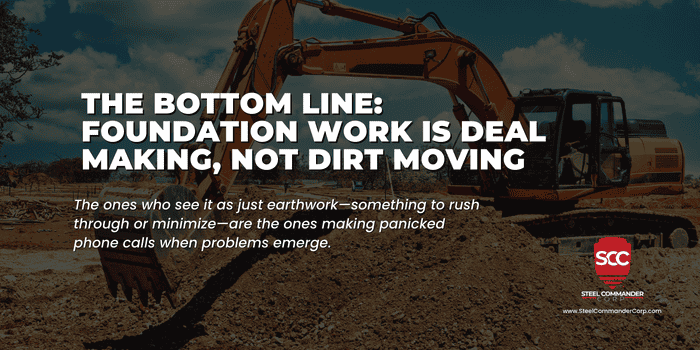
The Bottom Line: Foundation Work Is Deal Making, Not Dirt Moving
In construction, there’s an old saying: “The bitterness of poor quality remains long after the sweetness of low price is forgotten.” Nowhere is this more true than in foundation and site preparation work.
The contractors and building owners who understand that proper site prep is a strategic investment are the ones whose projects come in on time, stay within budget, and perform well for decades. The ones who see it as just earthwork—something to rush through or minimize—are the ones making panicked phone calls when problems emerge.
At Steel Commander Corp, we’re committed to making sure every building we’re involved with starts with a foundation that sets it up for long-term success. Because at the end of the day, you can’t build a great steel structure on a shaky foundation. The ground beneath your building isn’t just dirt—it’s the bedrock of your entire investment.
Ready to start your next steel building project the right way? Contact Steel Commander Corp to discuss how proper foundation planning and site preparation can save you time, money, and headaches down the road. We’re here to make sure your project is built to last—from the ground up.